
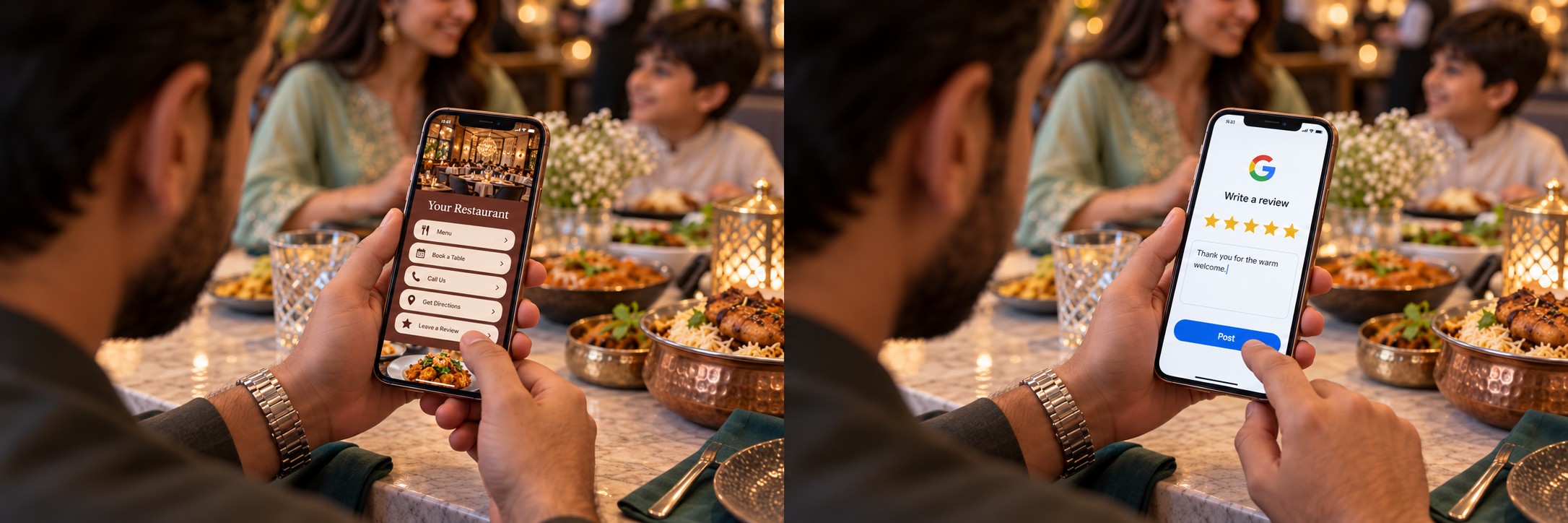
Your five-part Ramadan restaurant strategy
One connected plan: prepare the service, confirm the table, communicate clearly, organise generosity and listen to every guest.
- Planning
- Reservations and booking
- Notifications and communication
- Guest involvement and generosity
- Feedback, reviews and return visits
Explore TapX’s restaurant solutions or browse solutions by business segment.
This Ramzan, prepare the experience before you promote the feast
Picture the minutes before Iftar. A family reaches your entrance, a rider asks for a takeaway parcel, someone calls about a booking, and a guest wants to know whether the buffet price includes drinks. In the kitchen, your team is doing everything it can. At the reception desk, three different conversations contain three different versions of the reservation list. The food may be wonderful. The experience already feels uncertain.
Now imagine a different evening. Guests know where to arrive, what their package includes and who confirmed their table. Your host has one booking record. The current menu is easy to open. A colleague owns the pickup queue. A sponsored meal has a clear handover plan. After the feast, feedback reaches someone who can act on it. This is what a restaurant digital engagement plan should make possible: thoughtful hospitality supported by clear information and organised people.
Ramadan, Ramzan or Ramazan: however your guests spell it, the invitation carries warmth, togetherness and responsibility. For restaurants across Pakistan, February 2027 is the expected planning window for the start of Ramadan. Final dates remain subject to Pakistan’s official moon-sighting announcement. Keep launch dates flexible until confirmed, and use locally verified Sehri and Iftar timings for each city. An attractive national campaign must never leave a branch using another city’s timetable.
This guide is for the neighbourhood restaurant, the busy café, the family buffet, the fine-dining venue and the multi-branch group. Its five-part strategy connects planning; reservations and booking; notifications and communication; guest participation and generosity; and feedback, reviews and return visits. Around those five parts sit local presence, social content, AI discoverability, sensible advertising and the enterprise QR controls that keep every route working.
The most memorable Iftar begins with a promise your team is ready to keep.
How ready is your restaurant?
Use this working checklist with your team. Your selections stay on this page only; nothing is submitted or stored.
0 of 10 preparation items checked. Start with the next unchecked responsibility.
This is a planning aid, not a readiness certification or prediction of bookings.
1. Planning: build one service promise your whole team understands
Start with the guest experience, before choosing a poster, discount or advertising audience. Who are you preparing to welcome? Families with children need clear pricing, comfortable arrival and patient service. Office groups need a dependable organiser contact and a written package. Older guests may need an easier entrance or a printed menu. A small gathering may prefer a calm à la carte meal over a crowded buffet. Decide which experiences your venue can deliver well, then build the Ramadan offer around them.
Create one approved Ramadan service sheet. Include your branch address, contact numbers, dining windows, menu versions, package inclusions, applicable taxes or service charges, children’s pricing, deposit terms, cancellation conditions and accessibility information you have actually checked. Assign a named owner to every fact. A restaurant manager approves availability; the kitchen approves menu changes; the person responsible for finance confirms prices. Every public channel should draw from this source rather than from someone’s memory.
Design the evening around the moments that matter
Walk the journey in sequence: discovery, enquiry, booking, arrival, seating, Iftar, prayer arrangements where available, dining, payment and departure. At each moment ask, ‘What might a guest have to ask twice?’ That question reveals useful improvements. Put the parking guidance beside the location link. Explain the buffet inclusions beside the price. Give the reception team the same cancellation wording as the booking team. Keep printed alternatives for guests who cannot scan, have no data or simply prefer personal assistance.
| Decision | Write down | Accountable owner |
|---|---|---|
| Dining capacity | Serviceable seats, table mix, group limits and walk-in allowance | Restaurant manager |
| Menu and pricing | Current menu, inclusions, exclusions and effective date | Kitchen and finance leads |
| Guest journey | Arrival, assistance, prayer information and payment options | Floor supervisor |
| Digital destinations | Approved page, menu, enquiry route and branch contacts | Content owner |
| Generosity programme | Partner, meal allocation, handover and reconciliation | Programme lead |
Give the team a realistic preparation runway. Six weeks before the expected start, settle the offer and capacity. Four weeks before, prepare pages, menus, photography and scripts. Two weeks before, rehearse an enquiry, a changed booking and a full-house evening. In the final week, verify every link, confirm opening dates and train the people covering each shift. These are suggested milestones, not deadlines imposed by a platform; a smaller restaurant can compress them without skipping the decisions.
Build a fallback into the plan. Keep an accessible booking sheet, a current printed menu and a telephone contact if connectivity fails. Know who can stop an advertisement, correct a price or temporarily close a reservation request route. Technology supports the people delivering hospitality; someone must still make the service decision. The strongest Ramadan preparation plan is one your reception, kitchen, marketing and management teams can explain consistently before the first guest arrives.
2. Reservations and booking: turn every enquiry into a clear next step
A message asking ‘Table for eight?’ is an enquiry, not a confirmed reservation. Treating it as a booking before checking capacity creates avoidable disappointment. Use explicit stages: requested, awaiting details, provisionally held, confirmed, changed, cancelled and attended. One person or authorised team should maintain the shared record. If your restaurant uses a reservation platform, agree how enquiries reach it. If it uses a simple managed sheet, define who updates it and how shift handover works.
Collect only what the team needs: guest name, contact number, branch, date, party size, preferred dining window and relevant practical requests. Ask about dietary requirements without promising an accommodation the kitchen has not confirmed. Do not ask for identity documents or unrelated personal details just because a form can collect them. Explain what happens next and when the guest should expect a response. If a provisional hold expires, state the deadline clearly rather than quietly giving the table away.
Send a confirmation that removes uncertainty
A useful confirmation includes a booking reference, date, branch, confirmed party size, arrival guidance, agreed package, total-price basis and a contact for changes. Where a deposit applies, communicate the amount, approved payment route, receipt process and cancellation or refund terms before asking for payment. Do not put card details in an open chat. Your team should reconcile the payment and the reservation record rather than assuming a screenshot proves a settled transaction.
| Guest action | Restaurant response | Record state |
|---|---|---|
| Sends an enquiry | Acknowledge and request missing essentials | Requested |
| Chooses a suitable slot | Check actual table and service capacity | Provisional, if a hold is agreed |
| Completes agreed requirements | Send explicit written confirmation | Confirmed |
| Changes numbers or timing | Recheck availability and reconfirm | Changed, then confirmed |
| Arrives at the restaurant | Match the reference and update attendance | Attended |
Plan capacity as a service constraint. Eighty seats do not necessarily mean eighty covers can arrive together: table sizes, kitchen output, accessibility needs, staffing and buffet flow affect what is manageable. Keep a deliberate walk-in allowance if it suits your model, and maintain a waitlist without promising unavailable tables. When a slot is full, offer an honest alternative: another date, a later dining window where feasible, a takeaway package or another branch with confirmed availability.
For corporate Iftar bookings, agree a single organiser, final headcount deadline, invoice contact and menu approval. For large family groups, explain any seating limitations early. Test duplicate enquiries: the same guest may contact Instagram, WhatsApp and reception. Merge them into one reference rather than reserving three tables. Measure confirmed parties and attended covers separately. TapX can help design the branded request journey and handover; automatic live inventory, deposit processing or POS integration must be specifically agreed and tested, never assumed from the presence of a QR code.
See how TapX connects a restaurant’s physical touchpoints with its digital guest journey.
A reservation feels welcoming when the guest knows what is confirmed and the host knows what is expected.
3. Notifications and communication: make every message useful
Restaurant communication during Ramadan should reduce effort for guests and staff. Map messages to a real need: answering an enquiry, confirming a table, explaining a change, helping someone find the entrance or checking whether a problem was resolved. A daily promotional blast to every number in last year’s booking sheet is not a communication strategy. It creates work, invites unwanted messages and confuses the difference between helping with a booking and advertising a new offer.
Keep service communication and optional marketing distinct. Tell guests what updates are connected to their request. Separately invite them to opt in to future menus, events or loyalty messages, with a clear way to stop. Record their choice and respect it across channels. For the WhatsApp Business Platform, use the permissions, message categories, templates and delivery rules applicable to your setup. A click-to-WhatsApp link opens a conversation; it does not automatically create permission for unlimited follow-up or a fully automated messaging programme.
Build a small message library your team can trust
Prepare short, approved responses for common situations. Use placeholders for the facts your team must verify, such as [branch], [date], [confirmed party size] and [reference]. Keep Urdu, Roman Urdu and English versions understandable rather than translating mechanically. ‘Your request has been received; our team will confirm availability’ is different from ‘Your table is confirmed.’ Never use a cheerful automatic reply to imply a person has checked the booking when nobody has.
| Moment | Purpose | Check before sending |
|---|---|---|
| Enquiry received | Explain response time and next step | Correct branch and available team |
| Booking confirmed | Summarise the agreed arrangement | Actual confirmation and reference |
| Before the visit | Share useful arrival and change information | Current date, location and consent context |
| Unexpected change | Explain the issue and offer a practical choice | Approved remedy and responsible contact |
| After the visit | Offer feedback and resolve outstanding issues | Actual visit and appropriate contact permission |
Choose a notification rhythm around usefulness, not volume. One timely confirmation and one helpful reminder may serve a guest better than repeated countdowns. Let people change their party size or cancel through an obvious route. If they opt out of promotion, update the record promptly; do not make them explain themselves to several staff members. Plan who covers communication during the pre-Iftar rush so a guest does not receive contradictory answers from reception, the social media manager and the branch account.
Treat your Social Pack as an organised content service: verified menu artwork, an explanatory carousel, a short venue walkthrough, practical booking answers and timely availability updates. Use genuine images or clearly identified illustrations, readable captions and appropriate permissions for people shown. Schedule around your ability to respond, not an assumed universal ‘best time.’ A post attracting enquiries while your team is unavailable needs a clear response-time message. The content calendar and the duty roster should support each other.
Give every campaign a consistent destination. Instagram, Facebook, Google, a printed standee and a takeaway insert can lead to the same approved Ramadan page, with source labels where measurement is configured. That page should make the menu, branch, enquiry option and important terms obvious. When the offer changes, update the source first, then the scheduled content and staff scripts. A coherent communication strategy helps a restaurant sound like one attentive host across many channels.
Message permissions and delivery: WhatsApp Business Messaging Policy.
4. Guest involvement and generosity: organise the good you want to do
Ramadan hospitality includes more than the meal sold at a table. It can include a thoughtful welcome, a quieter conversation, a meal shared with someone who needs it and a staff team whose own Iftar has been planned with care. Blessings and generosity deserve sincerity. Do not turn every act of contribution into a lead-generation mechanism. Let people participate comfortably, including those who prefer to give privately or not participate in a public campaign.
If you offer sponsored Iftar meals, settle the process before inviting contributions. Name the organiser and intended recipient organisation, describe the meal and agreed cost, state any charges, explain collection and delivery arrangements, and decide how you will report fulfilled meals. Verify the recipient’s payment details through a trusted channel. Where donations go directly to a partner, send guests to that partner’s verified destination. A digital engagement page can explain the initiative; it should not imply TapX itself collects, holds or distributes charitable funds.
Make contribution transparent without making people a spectacle
Separate contributions requested, funds received, meals prepared, meals handed over and meals actually distributed. These are different events. Publish only figures you can reconcile with your partner and clearly explain what each figure means. Obtain permission before sharing identifiable images, and protect the dignity of recipients. A smiling photograph is not a substitute for a reliable delivery record. Agree how unused funds, missed collections or excess prepared meals will be handled before they become an end-of-night problem.
| Idea | Organise first | Keep separate |
|---|---|---|
| Sponsor an Iftar meal | Verified partner, cost, collection and handover | Donation and marketing consent |
| Community dining | Capacity, welcome, accessibility and service responsibilities | Guest dignity and publicity |
| Staff meal contribution | Fair arrangements and responsible oversight | Employment duties and public promotion |
| Responsible surplus redistribution | Suitable partner and safe handling arrangements | Food prepared and food safely accepted |
Guest involvement can also be simple: inviting suggestions for an inclusive family menu, sharing a consent-based community story, or offering an optional way to contribute a meal. Keep donation links away from automatic checkout additions. Never make a review, a five-star rating, a social follow or a contact-list subscription a condition of participation. For questions about Zakat eligibility, tax treatment, charitable permissions or food redistribution requirements, involve the appropriate qualified advisers and partner organisation rather than treating a campaign page as the authority.
Build generosity into the evening’s organisation. Allocate a staff member, a collection time, a packaging responsibility and a handover contact. Check that contribution activity does not obstruct guests arriving for reservations or delivery riders collecting orders. Celebrate the care your team put into the programme without claiming a social impact that has not been verified. A memorable Ramadan feast can be generous, dignified and well managed at the same time.
Generosity becomes dependable when someone takes responsibility for the handover.
5. Feedback, reviews and return visits: listen while you can still help
A guest who quietly leaves disappointed is giving you no chance to recover the experience. Make it easy to ask for help during the visit. A clearly labelled feedback route on the guest page can identify the branch, visit context and issue without requiring an essay. Assign a real recipient and escalation process. Collecting feedback in a dashboard nobody opens is not service recovery. Your floor team should also be approachable when someone would rather speak than scan.
Private feedback and public Google reviews serve different purposes. The first helps you understand and act on a concern; the second lets a customer independently share an experience with others. Offer both clearly and equally. Do not send happy guests to Google while diverting unhappy guests into a private-only form. Do not exchange discounts, meals, donations or loyalty rewards for any review. Do not provide scripted praise, required service keywords or a requested star rating.
Close the loop with the guest and with your team
A neutral review invitation is enough: ‘Thank you for visiting. If you would like, please share an honest review of your experience.’ The guest chooses the words and rating. When responding, acknowledge what they actually said and explain any useful next step without exposing personal information. If you need booking details to investigate, move that conversation to an appropriate private channel. Keep public replies specific and respectful, including when your team remembers the evening differently.
At the end of each service, review recurring issues rather than simply counting scores. Were guests unclear about drinks? Did large parties arrive without a final headcount? Was the menu slow to load? Did a contribution handover collide with the takeaway queue? Assign an improvement, a person and a completion time. On the next shift, tell the team what changed. This is where a feedback collection system creates operational value: the restaurant actually becomes easier to visit.
| Measure | What it tells you | What it does not prove |
|---|---|---|
| Confirmed enquiries | Requests your team accepted | Attendance or payment |
| Attended covers | Guests recorded as served | Satisfaction or repeat visits |
| QR/menu opens | Activity on an access route | Unique diners or completed orders |
| Feedback resolved | Issues closed under your process | That every guest was satisfied |
| Voluntary reviews | Public customer contributions | Guaranteed Maps ranking |
When Ramadan ends, keep the relationship only where guests have chosen it. An opted-in Eid greeting, a useful updated menu or an invitation to a suitable future event can continue the conversation. Avoid treating every reservation number as a permanent advertising audience. Retain guest information only for a clear purpose and an agreed period. A successful Ramadan restaurant marketing strategy should leave behind a stronger service process and willing relationships, not just a larger spreadsheet.
Explore the restaurant solution’s approach to guest feedback and reputation.
Public review guidance: Google’s contribution policy and review invitations and replies.
Be easy to find: local presence, social discovery and AI visibility
A guest searching for ‘Iftar buffet Lahore,’ ‘Sehri restaurant Karachi’ or ‘family Iftar Islamabad’ needs a practical answer, not a wall of repeated keywords. Create a useful Ramadan page for the actual restaurant and branch. Explain the offer, location, dates once confirmed, dining windows, price basis, inclusions and booking process. Use the spellings Ramadan, Ramzan and Ramazan naturally where they help readers. Search phrases are examples of intent, not verified search-volume data or promised ranking opportunities.
Keep your Google Business Profile, website and social bios consistent. Check the phone, map pin, current menu link, business category and customer-facing dining hours. For a month-long seasonal change, use accurate seasonal operating hours as appropriate; use special hours for individual exceptions, and restore the ordinary schedule afterward. Where the profile supports separate service hours, distinguish dining, takeaway and delivery accurately. Google’s business-hours guidance should determine the configuration, not a blanket instruction to label every restaurant open twenty-four hours.
Give people and AI systems the same clear facts
Publish useful answers in readable page text: Is advance booking required? Are children charged differently? Is the advertised amount per person? Is parking available? Can the team accommodate the stated dietary request? Keep answers current and supported by real arrangements. Google’s guidance for AI features emphasises the same foundational SEO practices as Search; it does not require a special AI schema. No agency can promise inclusion in an AI answer, a featured result or a particular Google Maps position.
Use relevant structured data that matches visible information. An article should identify its actual author and publisher. A restaurant’s own page can describe the real establishment and menu where appropriate. Do not add invented ratings, customer counts, availability or endorsements. A useful FAQ section helps readers even without a special search appearance. Keep important content available as text, not only inside a menu image, Instagram caption or downloadable poster that leaves guests searching for basic details.
Give each branch its own accurate contact and arrival information without manufacturing dozens of near-identical neighbourhood pages. Review legitimate directory and partner listings for old addresses or numbers. On social media, pin the current Ramadan offer and booking instructions, then remove outdated versions. Local visibility is strongest as a consistent information service: someone discovers your restaurant, recognises the offer and reaches a team able to honour it. That is a better target than accumulating impressions while guests cannot find the entrance.
Further guidance: Google business hours and AI features and your website.
“Best Aftaar and Sehri deals near me”: be ready for the question
Your next guest might type into ChatGPT, ask Claude to compare options, or speak a question into a search or AI app. They may say Iftar, Aftaar, Aftar or Iftaar; Sehri or Suhoor; Ramadan, Ramzan or Ramazan. The useful opportunity is to publish an accurate answer to the decision behind those words. Someone asking for the best nearby deal usually needs a suitable location, an understandable price, a meal that fits their group and a clear way to check availability.
Treat the following as illustrative questions a diner could ask, not recorded voice notes, search-volume evidence, live recommendations or verified restaurant deals. Voice-input availability and web-search behaviour depend on the app and its settings. A spoken question does not guarantee that any assistant knows the guest’s precise location: the city, neighbourhood or landmark may need to be supplied.
| Search situation | A natural question | Information your restaurant should publish |
|---|---|---|
| ChatGPT comparison | What are the best Iftar deals near Gulberg, Lahore for a family of six? | Branch, family seating, current package, full price basis and booking contact |
| Claude comparison | Compare Sehri deals in Clifton, Karachi, including prices and reservation requirements. | Readable menu, per-person charges, service dates and confirmation process |
| Spoken nearby request | Find an Aftaar buffet near me tonight. Is parking available? | Accurate location, current operating hours, verified parking and a way to check tonight’s availability |
| Roman Urdu voice-style question | Mere qareeb sehri ki achi deals kahan hain? Price aur booking ka tareeqa bata dein. | Neighbourhood, clear prices, understandable booking instructions and language support actually offered |
| Group-booking question | Which Islamabad restaurants can accommodate an Iftar group of twelve this Friday? | Group enquiry terms, branch contact and team-confirmed availability |
| Budget-led question | Are there Iftar deals around PKR 3,000 per person near me, including taxes? | Actual advertised price, taxes and service charges, inclusions, exclusions and valid dates |
Publish a deal people can understand and an assistant can cite
Give every Ramadan offer an accessible page with the restaurant’s real name, branch, neighbourhood, address, location link, menu, price basis, dates and dining windows. Explain whether the amount includes taxes, drinks and service charges. Add children’s pricing, group requirements and deposit or cancellation terms where applicable. State when the offer information was genuinely checked. Update sold-out dates promptly, and distinguish a reservation request from a confirmed table. A poster can attract attention; readable supporting text gives people something concrete to compare.
Answer practical nearby questions in plain language. ‘Our Gulberg branch entrance is on [verified street]’ is more useful than repeating ‘best Iftar buffet near me’ across every paragraph. Only describe parking, wheelchair access, prayer arrangements, delivery areas or dietary options you can actually provide. Use real restaurant and menu information in relevant structured data, matching the visible page. Do not mark up made-up deals, invented ratings or unconfirmed seat availability, and do not create a separate thin page for every spelling or spoken variation.
Make the public source accessible, then measure what actually happens
OpenAI’s publisher guidance identifies OAI-SearchBot access as relevant to inclusion in ChatGPT search summaries and snippets. Anthropic distinguishes Claude-SearchBot for search from Claude-User for user-directed retrieval. Search discovery and model-training crawlers have different purposes; permission for one should not be confused with permission for another. A site owner should check the actual robots rules, indexing signals and hosting access for the public offer page while continuing to protect private systems. Allowing a crawler is not a guarantee of indexing, recommendation or citation.
Ask guests how they found the restaurant when appropriate, inspect available referral and booking records, and keep any manual AI-search observations dated with the exact question and location context. A citation in one answer does not establish a stable ranking across every user or city. The objective is a guest who reaches current information and a team prepared to help. TapX can help plan the restaurant’s content, local presence and engagement routes; the restaurant remains the source of its deal, price and availability.
Publisher access guidance: OpenAI’s publisher FAQ and Anthropic’s crawler guidance.
Spend on demand you can serve: a practical Ramadan advertising strategy
Begin with capacity and contribution margin, not an arbitrary daily advertising spend. Decide which dates, branches and dining windows genuinely need more confirmed guests. Protect your kitchen and reception from campaigns promoting already-full evenings. The right next booking may be a midweek family group rather than another enquiry for your busiest Saturday. Separate creative production, programme setup and media spend in the budget so the owner understands what is being purchased.
Use the budget planner below as a discussion model, not a forecast. Its example split allocates twenty percent to discovery, thirty-five percent to booking intent, twenty percent to permitted follow-up audiences, fifteen percent to useful customer communication and ten percent to reserve. Customer communication can include production and approved delivery costs; it is not necessarily an advertising-platform purchase. Your own mix should change with capacity, existing demand, channel eligibility and evidence. No return or booking uplift is assumed.
A phased campaign beats a permanent boost button
Before launch, introduce the offer and answer objections with clear menu and venue content. As bookings open, concentrate on people looking for a meal your venue actually provides, using suitable local geography and truthful creative. During Ramadan, advertise the dates and availability your team has checked. After a strong evening, learn which source produced attended guests rather than simply increasing spend because a video collected views. Pause weak or confusing messages while you fix the destination.
Measure the full journey: spend, landing-page visits, relevant enquiries, confirmed parties, attended covers and attributable revenue where records support it. Count each enquiry once across channels. An advertising dashboard’s attributed conversion is not automatically a confirmed booking in your restaurant’s record. Use consistent campaign labels and ask how guests heard about you when useful. Compare results within a clear reporting window, and distinguish observed evidence from assumptions in any return-on-ad-spend calculation.
For illustration only, if you spend PKR 20,000 and can reasonably attribute twenty attended parties to the campaign, the acquisition cost is PKR 1,000 per attended party. That is not per person, profit or a promised TapX outcome. Decide whether the result is acceptable using the party’s actual contribution after food, service and other relevant costs. Where attribution is incomplete, say so. A small, honestly measured campaign is more useful than an impressive-looking report with an undefined denominator.
| Do | Do not |
|---|---|
| Promote verified available dates and packages | Keep selling a full slot through unattended ads |
| Check branch-level replies and capacity | Send all cities to one unclear inbox |
| Use truthful local creative and appropriate audiences | Infer or target a person’s religion from guest records |
| Use permitted audiences and honour opt-outs | Upload a booking list without an appropriate basis |
| Keep a reserve for changes and useful tests | Treat a suggested budget split as guaranteed ROI |
Choose a stop rule before you spend: unavailable capacity, an unanswered enquiry backlog, a broken menu destination or misleading pricing should trigger review. Plan when the manager and campaign operator will reconcile availability. TapX can help shape the engagement journey, content and measurement plan; advertising accounts, media buying, platform charges and integrations should be explicit in the agreed scope. A Digital Engagement Pack is valuable when ownership is clear, not when unrelated responsibilities disappear into a vague promise.
Build a budget you can discuss
Adjust an illustrative engagement budget. The chart shows a suggested allocation, not expected revenue or a TapX price quotation.
Include only costs you intend to allocate. Example shares total 100%.
| Purpose | Share | Amount |
|---|---|---|
| Discovery and useful content | 20% | Rs 20,000 |
| Booking-intent campaigns | 35% | Rs 35,000 |
| Permitted follow-up audiences | 20% | Rs 20,000 |
| Customer communication | 15% | Rs 15,000 |
| Reserve and learning | 10% | Rs 10,000 |
| Total | 100% | Rs 100,000 |
Illustrative allocation total: Rs 100,000. Separate media buying, production, messaging and setup costs in the actual proposal.
Adapt the plan to your kind of restaurant
The five-part strategy stays consistent, but the service design should reflect your venue. A café might need a focused Iftar platter and a manageable takeaway window. A buffet restaurant needs clear replenishment responsibilities and arrival guidance. A fine-dining venue may prioritise seating, dietary conversations and a carefully paced experience. A bakery-led outlet needs accurate collection cutoffs and parcel references. A multi-branch group needs common standards with local control over availability.
| Restaurant segment | Guest question to solve | Digital engagement priority |
|---|---|---|
| Family buffet | What is included, and is our table confirmed? | Package clarity, capacity and arrival instructions |
| Café or casual dining | Can we see the menu and ask about a table? | Fast menu access and a staffed enquiry route |
| Fine dining | Can you accommodate our party’s arrangements? | Personal confirmation and accurate service notes |
| Takeaway or catering | When and where do we collect? | Order-request references and collection communication |
| Restaurant chain | Is this offer valid at this branch? | Branch-specific pages and controlled updates |
Be equally specific about geography. Lahore, Karachi, Islamabad, Rawalpindi, Faisalabad, Multan, Peshawar, Quetta and other Pakistani cities have different guest journeys and local conditions. Verify the actual branch’s timings, access and service arrangements. Do not promise delivery coverage, prayer facilities or parking because another branch offers them. A national restaurant brand earns confidence when its local details are dependable.
The TapX All-in-One Engagement Pack: one connected programme
TapX’s role can begin before the first code is printed. The team can work with a restaurant owner to define the guest journey, approved content, enquiry responsibilities, feedback routes and practical rollout. The programme can bring together a branded digital profile, digital menu access, reservation and enquiry requests, WhatsApp contact, social connections, voluntary reviews, private feedback, local-presence work and a consent-based return-visit journey. Agree which elements are included, who operates them and what support is available.
Keep the enterprise window open. TapX’s Enterprise QR Management Platform supports the broader conversation around dynamic QR campaigns, controlled destinations and digital reach. A restaurant group can plan a consistent QR identity across tables, branches, takeaway packaging and seasonal campaigns while keeping the destination content current. Where analytics are included, agree the events being measured and their limits. Scans indicate activity on a route; they do not by themselves prove reservations, unique guests or sales.
Product authenticity and anti-counterfeit workflows can also matter to enterprise food brands selling packaged products, sauces, retail gift boxes or other suitable lines. Discuss the required product identity, evidence and verification process separately. A plain QR sticker is not proof of authenticity, and a Ramadan restaurant engagement package should not imply that every item receives a deployed verification system. Enterprise capabilities remain part of TapX’s wider offering, with implementation determined by the specific business requirement.
A useful proposal describes the deliverables, deployment responsibilities, training, maintenance, data handling, reporting and commercial terms. Demonstrate any requested reservation integration, automated notification, POS connection or payment flow before relying on it during service. The restaurant still confirms its tables, prepares its food and fulfils its guest commitments. TapX helps connect and organise the digital experience around those responsibilities. That clarity makes an all-in-one programme easier to trust and easier to run.
One connected guest journey is valuable when every handover has an owner.
Your final rehearsal: open the plan as if you were a guest
Before opening reservations, ask someone outside the project to find the offer on a phone. Can they read the menu without zooming? Is the price understandable? Can they identify the branch and ask for a table without creating an account? Ask reception to find that enquiry, check capacity and issue a confirmation. Then change the party size, close a full slot and test the fallback contact. A rehearsal finds confusion while you still have time to fix it.
- Test each QR from its actual printed size, placement and lighting; include an easy contact or readable link alternative.
- Check the menu, dates, location, available dining windows, charges and cancellation wording against the approved service sheet.
- Verify that feedback and public-review choices remain equally available, with no reward or sentiment-based routing.
- Rehearse one contribution handover and one guest complaint, with responsible people present.
- Confirm that the opening shift knows who can update content, stop ads and resolve an enquiry backlog.
Hold a short daily briefing throughout Ramadan: expected covers, changes, outstanding guest requests, takeaway collections and contribution responsibilities. Close each evening with what happened and what tomorrow needs. Keep the conversation practical and kind; a tired team needs useful decisions more than another dashboard. After the season, review the evidence, thank your guests and partners appropriately, remove expired offers and carry the strongest service improvements into the rest of the year.
The way you manage this Ramadan can be different. More prepared. More consistent. More generous with your guests’ time and your team’s attention. If you are a restaurant owner in Pakistan and want help developing and deploying a Ramadan Ready Digital Engagement Plan, connect with the TapX team. Bring your branch details, service model, approximate capacity and the experience you want to create. Together, define a realistic programme before the first campaign goes live.
Restaurant owners’ Ramadan questions, answered
How can my restaurant be discoverable when people ask ChatGPT or Claude for nearby Iftar and Sehri deals?
Publish a current, crawlable restaurant offer page with accurate branch and location details, menu, full price basis, dates, dining windows and booking instructions. Answer useful guest questions in readable text and verify crawler access. These steps support discovery; they do not guarantee an AI citation, recommendation or search position.
Should I use ‘best Aftaar deals near me’ and Roman Urdu voice-style questions on my restaurant website?
Use relevant wording naturally in a helpful FAQ, alongside real city, neighbourhood and offer details. Guests may say Iftar, Aftaar, Sehri, Suhoor or ask in Roman Urdu. Examples can guide useful answers, but do not invent rankings, record fictional voice testimonials or repeat keywords without adding information.
When should restaurants in Pakistan prepare for Ramadan 2027?
Begin before the expected February 2027 start, ideally with several weeks for service planning, content, staff training and rehearsal. Final Ramadan dates in Pakistan depend on the official moon-sighting announcement. Confirm city-specific Sehri and Iftar timings rather than copying another city’s schedule.
What are the five parts of a Ramadan restaurant engagement strategy?
Planning the service; managing reservations and booking; organising notifications and communication; supporting guest involvement and generosity; and collecting feedback, voluntary reviews and consent-based return interest. Each part needs a responsible person, current information and a clear handover to the next.
Can a QR code confirm restaurant reservations automatically?
A QR can open a reservation request or a connected booking destination. It does not itself check table inventory or confirm a seat. Automatic availability, deposits, payments and booking integrations require a specifically configured and tested workflow. Otherwise, your team confirms the request.
What should a digital Iftar or Sehri menu include?
Show current dishes, price basis, relevant charges, inclusions, exclusions, branch, available dates and dining windows. Explain children’s pricing, dietary enquiries and booking steps where relevant. Make the menu readable on a phone and keep staff or printed help available for guests who prefer it.
How much should a restaurant spend on Ramadan ads?
There is no universal amount. Start with service capacity, margin, available dates and an affordable test budget. Separate production, setup and media costs. Track confirmed and attended guests where attribution supports it. The planner on this page illustrates allocations; it does not forecast bookings or profit.
Can TapX help with local presence, Social Packs and AI visibility?
TapX can discuss accurate business information, restaurant content, local visibility analysis and connected customer journeys within an agreed scope. Useful, accessible pages support discoverability. Google Maps rankings, AI citations, impressions and sales cannot be guaranteed; assess changes using dated evidence and clear measures.
Should donations, loyalty rewards and Google reviews be connected?
Keep them independent. Giving, loyalty participation and public reviews should be voluntary choices. Do not reward any review, require a particular rating or decide who gets a public-review link based on satisfaction. Use a verified partner and transparent arrangements for any contribution programme.
Can I send Ramadan promotions to everyone who booked previously?
Do not assume a booking creates permission for future marketing. Use an appropriate opt-in process, explain the messages people can expect and honour opt-outs. Follow the WhatsApp Business rules for your chosen product, including applicable message templates, categories and delivery conditions.
Does the restaurant programme include Enterprise QR and anti-counterfeit solutions?
Enterprise QR management remains part of TapX’s broader offering. Discuss dynamic campaign management, branch destinations, analytics and any product-authenticity requirement during scoping. Anti-counterfeit workflows for suitable packaged products are a separate implementation decision, not an automatic feature of every restaurant package.
How do I discuss a Ramadan Ready programme with TapX?
Contact the TapX team on WhatsApp or through the contact page. Share your restaurant’s city, branches, service model, approximate capacity, planned offer and main operational challenges. The team can help define scope, responsibilities and a rollout plan before any commitment or deployment.
Bring your restaurant.
Let’s build the plan.
From your first planning conversation to an agreed rollout, connect with TapX about a Ramadan Ready Digital Engagement Pack built around your guests, team and enterprise requirements.
I’m a restaurant owner. Let’s discuss. Prefer the contact page?Explore your next step
Sources and editorial notes
Prepared on 23 November 2026. Platform guidance can change; recheck before launch. February 2027 is a planning expectation, not an announced Pakistan start date. Quotes are original editorial principles, not customer testimonials. Budget allocations and numerical examples are illustrative.
- Ramadan 1448 planning calendar — World Federation (calculated dates; local confirmation required)
- Google: business representation, seasonal and restaurant operating hours
- Google: setting special hours for individual exceptions
- Google: relevance, distance and prominence in local ranking
- Google Search Central: AI features and your website
- OpenAI: publisher discovery and ChatGPT search crawler access
- Anthropic: Claude search and user-directed retrieval crawlers
- Google Maps: genuine reviews and rating manipulation policies
- Google: review invitations and helpful owner replies
- WhatsApp Business Messaging Policy
Written by Abdullah Alam for TapX Pakistan. Restaurant service decisions, contribution arrangements and deployment scope should be confirmed with the responsible team.